
Starting a psychiatric medication is rarely the end of the treatment process.
For many people, it is the beginning of an ongoing conversation with their psychiatric provider.
Psychiatric medication management involves evaluating how a medication is working, monitoring symptoms and possible side effects, reviewing dosage, discussing changes in your health, and determining whether the current treatment plan should remain the same or be adjusted.
That is why follow-up appointments can be an important part of psychiatric care.
You do not necessarily need a medication change every time you meet with your provider. Sometimes the purpose of the visit is simply to understand whether your current treatment continues to make sense.
This guide explains what psychiatric medication management means, what usually happens during follow-up care, what information your provider may ask about, and how telepsychiatry can make ongoing psychiatric appointments more accessible.
Table of Contents
What Is Psychiatric Medication Management?
Psychiatric medication management is the ongoing process of evaluating, prescribing, monitoring, and reviewing medications used as part of mental health treatment.
It can include several stages:
- Reviewing symptoms
- Discussing treatment goals
- Considering whether medication may be appropriate
- Selecting a medication when indicated
- Reviewing dosage
- Monitoring effectiveness
- Discussing possible side effects
- Checking for changes in other medications or health conditions
- Adjusting treatment when appropriate
- Planning ongoing follow-up care
Medication management is therefore broader than simply writing a prescription.
The American Psychiatric Association notes that people taking psychiatric medications should have follow-up visits so their provider can assess whether the medication is having the intended effect and discuss possible side effects. Medication or dosage may sometimes need to be adjusted based on the individual’s response.

For some people, psychiatric medication may be used for a relatively limited period.
For others, ongoing treatment may be recommended.
The approach depends on the condition being treated, individual response, health history, and the provider’s clinical assessment.
Why Does Medication Management Matter?
Two people taking the same medication may not have exactly the same experience.
A medication that works well for one person may be less effective for another. Some people may experience side effects while others do not.
Symptoms can also change over time.
That is why medication treatment often requires monitoring rather than a one-time decision.
Follow-up care gives the provider an opportunity to understand questions such as:
- Have your symptoms changed?
- Are you noticing any improvement?
- Have new symptoms appeared?
- Are you experiencing side effects?
- Are you taking the medication consistently?
- Has anything changed in your physical health?
- Are you taking any new medications or supplements?
- Is the treatment helping with daily functioning?
- Does the current plan still make sense?
The goal is not necessarily to change medication frequently.
Instead, medication management creates an opportunity to periodically evaluate whether your current treatment remains appropriate.
What Happens Before Medication Is Prescribed?
Psychiatric medication management generally begins with an evaluation.
A provider needs to understand what you are experiencing before discussing possible treatment options.
That evaluation may include questions about:
- Current symptoms
- Mental health history
- Previous diagnoses
- Previous psychiatric medications
- Current prescriptions
- Medical conditions
- Sleep
- Mood
- Concentration
- Energy
- Anxiety
- Substance use when relevant
- Family history
- Previous treatment response
- How symptoms affect everyday life
Your provider may also ask why you are seeking care now.
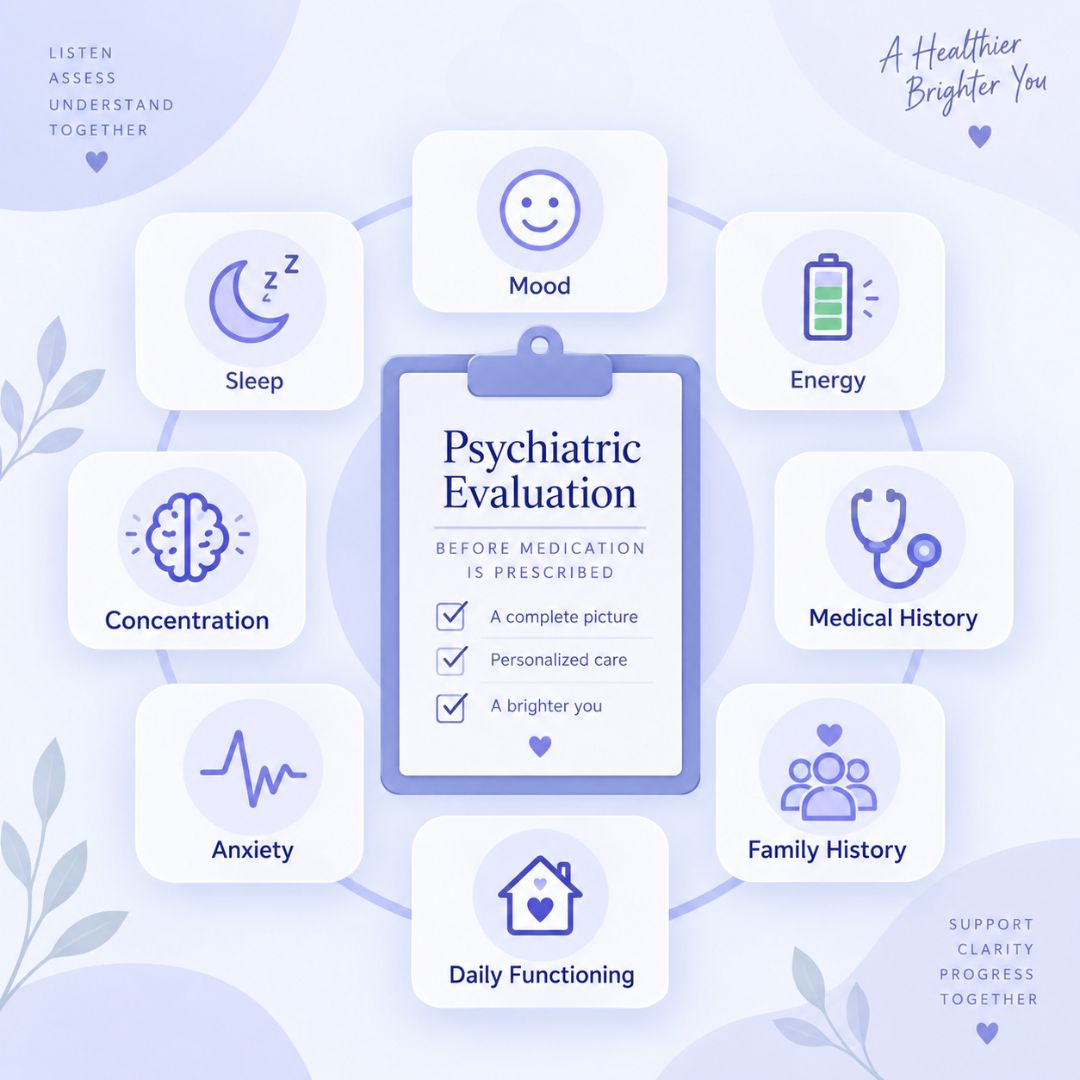
For example, someone experiencing difficulty concentrating may have several possible factors contributing to the problem.
Likewise, sleep problems, anxiety, low mood, changes in energy, or irritability can have different causes.
A psychiatric evaluation helps provide context before treatment decisions are made.
Medication is not automatically recommended simply because someone schedules a psychiatric appointment.
Depending on the evaluation, your provider may discuss medication, therapy, lifestyle changes, additional testing, another healthcare professional, or a combination of approaches.
What Happens During a Medication Management Appointment?
A medication management visit usually focuses on what has happened since your previous appointment.
Your provider may begin with a relatively simple question:
How have you been doing since we last spoke?
From there, the conversation becomes more specific.
Your Symptoms
Your provider may ask whether the symptoms that originally brought you to treatment have changed.
For example:
- Is your anxiety occurring less frequently?
- Has your mood changed?
- Are you sleeping better?
- Has your concentration improved?
- Are panic symptoms still occurring?
- Has your motivation changed?
These questions help determine whether there has been meaningful progress.
Your Medication Experience
You may also discuss how you are experiencing the medication itself.
That can include:
- When you take it
- Whether you are taking it consistently
- How long you have been taking it
- Whether you have noticed benefits
- Whether you have noticed unwanted effects
- Whether you have missed doses
- Whether taking the medication has been difficult for any reason
There is no advantage in telling your provider what you think they want to hear.
Medication management works best when you describe your actual experience.
Changes Since Your Previous Visit
Even changes that do not initially seem related to mental health can be worth mentioning.
Tell your provider about things such as:
- New prescriptions
- Over-the-counter medications
- Supplements
- Significant medical diagnoses
- Pregnancy or plans for pregnancy
- Changes in alcohol or substance use
- Major changes in sleep
- Significant changes in appetite or weight
- Other healthcare treatments
This helps your provider evaluate your psychiatric treatment within the broader context of your health.
What Does a Psychiatric Provider Monitor?
Medication management usually involves more than asking whether you feel “better.”
Providers may look at several aspects of your response.
Symptom Changes
One of the most important questions is whether the symptoms being treated have improved, remained unchanged, or worsened.
That might involve changes in:
- Mood
- Anxiety
- Sleep
- Concentration
- Motivation
- Energy
- Irritability
- Panic symptoms
- Daily functioning
Side Effects
Some psychiatric medications can cause unwanted effects.
The specific possibilities depend on the medication.
Your provider may ask whether you have noticed anything new since starting or changing treatment.
Side effects should be discussed rather than ignored, particularly if they are persistent, disruptive, unexpected, or concerning.
Daily Functioning
Symptoms do not exist only on a checklist.
Your provider may also want to understand whether treatment is making everyday life easier.
For example:
- Is it easier to complete work?
- Are you sleeping more consistently?
- Are you able to focus longer?
- Are you participating in activities again?
- Are symptoms interfering less with relationships?
- Are everyday responsibilities becoming more manageable?
These practical changes can provide additional information about how treatment is working.
Adherence
Providers may ask whether you are taking the medication as prescribed.
If you sometimes forget doses or have stopped taking the medication, say so.
This information helps your provider interpret your response accurately.
When Might a Medication or Dose Be Adjusted?
A medication plan may be adjusted for many reasons.
For example, a provider may consider a change if:
- Symptoms remain significant
- Improvement has been limited
- Side effects are difficult to tolerate
- Symptoms have changed
- The medication seems to be helping only partially
- Another health condition has developed
- Another medication has been added
- Your treatment goals have changed
An adjustment could mean several different things.
The provider might discuss changing the dose, changing when the medication is taken, continuing the same treatment for longer, switching medications, or considering another approach.
A medication change is not necessarily a sign that treatment has failed.
Finding an appropriate treatment plan can sometimes require observation and adjustment over time.
The American Psychiatric Association notes that some psychiatric medications may take several weeks or longer to produce their full benefit, depending on the medication.
That is one reason follow-up care matters.

How Often Are Psychiatric Medication Follow-Ups?
There is no single follow-up schedule that applies to everyone.
The frequency of appointments can depend on:
- Whether you recently started medication
- Whether your dose recently changed
- The medication being used
- Your symptoms
- Side effects
- Your diagnosis
- How stable your treatment has been
- Your provider's recommendations
Someone beginning a new treatment may need closer follow-up than someone who has been stable on the same treatment for a longer period.
As treatment becomes more established, appointments may sometimes become less frequent.
Your provider should explain what follow-up schedule is appropriate for your situation.
What Should You Tell Your Provider During Follow-Up Care?
You do not need to prepare a detailed report for every appointment.
However, a few specific observations can make medication management more useful.
Instead of saying:
“I think it’s working.”
You might explain:
“I am sleeping through the night more often, but I still feel anxious in the afternoon.”
Instead of:
“I don’t like this medication.”
You might say:
“My concentration has improved, but I have noticed that I feel more restless after taking it.”
Specific examples help your provider understand both potential benefits and problems.
Consider discussing:
- What has improved
- What has not improved
- Any new symptoms
- Possible side effects
- Changes in sleep
- Changes in appetite
- Changes in energy
- Changes in concentration
- Missed doses
- Other medications
- Questions or concerns
You should also mention if you are thinking about stopping the medication.
That conversation is part of medication management too.
Psychiatric Medication Management Through Telepsychiatry
Medication follow-ups do not always require an in-person office visit.
Telepsychiatry can allow psychiatric medication management to take place through virtual appointments when telehealth is appropriate for the patient’s situation.
The American Psychiatric Association identifies continuity of care and follow-up as potential benefits of telepsychiatry and supports telemedicine as a component of psychiatric care when it meets appropriate clinical, privacy, ethical, and legal standards.
At Blue Lily Psychiatry, sessions are conducted through a virtual office using video appointments, and prescriptions can be sent electronically to the patient’s pharmacy when medication is prescribed.
This can make ongoing appointments easier for people who would otherwise need to repeatedly travel to a psychiatric office.
A typical process may look like this:
Psychiatric evaluation → treatment plan → medication when appropriate → follow-up → monitoring → adjustments when necessary

Medication Management vs. Psychiatric Evaluation
These services are closely related, but they are not exactly the same.
Psychiatric Evaluation
A psychiatric evaluation typically provides a broader initial assessment.
The provider may explore:
- Current symptoms
- Mental health history
- Medical history
- Previous treatment
- Family history
- Current medications
- Daily functioning
- Possible diagnoses
- Treatment options
The goal is to better understand what you are experiencing and determine appropriate next steps
Psychiatric Medication Management
Medication management generally becomes more relevant once medication is being considered or is already part of the treatment plan.
The focus shifts toward questions such as:
- Is the medication helping?
- Are there side effects?
- Is the dose still appropriate?
- Have symptoms changed?
- Should treatment remain the same?
- Is another approach worth considering?
The two often work together.
An evaluation helps establish the treatment plan, while follow-up medication management helps determine how that plan is working over time.
How to Prepare for a Medication Follow-Up
Preparing for a psychiatric medication appointment does not need to be complicated.
Before the visit, think about what has changed since your previous appointment.
It may help to write down:
- Current medications and doses
- Any medications you recently stopped
- New medications from other providers
- Supplements you take
- Symptoms that have improved
- Symptoms that remain
- Possible side effects
- Changes in sleep
- Changes in mood
- Changes in concentration or energy
- Questions you want to ask
If something unusual happened after starting or changing medication, make a note of when it occurred.
You can also bring information from another healthcare provider if you think it may be relevant.
The goal is simply to give your psychiatric provider an accurate picture of what has happened since the previous visit.
What If Your Medication Does Not Seem to Be Working?
Not noticing improvement immediately does not always mean a medication will never work.
Different psychiatric medications have different timelines, and some can take time before their full effects are apparent.
However, you should tell your provider if:
- You have noticed little or no improvement
- Symptoms are getting worse
- Side effects are difficult to manage
- You feel significantly different after starting treatment
- You are struggling to take the medication consistently
- You are considering stopping it
Your provider can use that information to decide whether more time, an adjustment, another medication, or another approach should be considered.
Do not assume you have to continue silently with a medication that concerns you.
Questions and concerns are part of the follow-up process.
Can You Stop Psychiatric Medication on Your Own?
If you are considering stopping a psychiatric medication, discuss it with the prescribing provider first whenever possible.
Stopping certain medications suddenly can cause withdrawal symptoms, a return of symptoms, or other problems.
The appropriate approach depends on the specific medication, dose, length of treatment, and individual circumstances.
A provider may recommend gradually reducing a medication rather than stopping immediately.
Similarly, do not increase or decrease a psychiatric medication on your own unless your provider has specifically given you instructions to do so.
Medication management exists partly to make these changes in a more structured way.
Our Services Offers
Choosing a Provider for Psychiatric Medication Management
If you are looking for psychiatric medication management, consider more than whether someone can prescribe medication.
Ongoing treatment involves a relationship with the provider.
Does the Provider Offer Psychiatric Evaluations?
Medication decisions should begin with an appropriate evaluation rather than being treated as a stand-alone transaction.
Is Follow-Up Care Available?
Find out what happens after your initial appointment.
Does the practice provide ongoing medication appointments?
How are treatment changes handled?
Can Appointments Be Completed Online?
If convenience is important, telepsychiatry may allow you to attend follow-up visits from home when virtual care is appropriate.
Does the Provider Practice in Your State?
Telepsychiatry is still subject to professional licensing and state-specific requirements.
Blue Lily Psychiatry currently lists licensed service locations across multiple states.
You can review current locations here.
Who Will Provide Your Care?
Blue Lily Psychiatry’s clinical team includes board-certified Psychiatric Mental Health Nurse Practitioners, including providers experienced with conditions such as anxiety, depression, ADHD, insomnia, and bipolar disorder.
You can meet the Blue Lily Psychiatry providers before scheduling.
Getting Started With Psychiatric Medication Management
Psychiatric medication is not usually something that should be viewed as a one-time prescription.
Effective medication management involves evaluating how treatment fits into your broader mental health care.
That means asking questions, monitoring symptoms, discussing side effects, reviewing changes, and adjusting the plan when appropriate.
If you are considering psychiatric treatment for the first time, the process may begin with a comprehensive evaluation.
If you already take psychiatric medication, follow-up care can help determine whether your current treatment continues to meet your needs.
Blue Lily Psychiatry provides virtual psychiatric services through telepsychiatry, allowing patients in supported states to complete psychiatric appointments from home.
Learn more about Telepsychiatry or book an online appointment to get started.
Frequently Asked Questions About Psychiatric Medication Management
What does psychiatric medication management mean?
Psychiatric medication management is the ongoing process of evaluating how psychiatric medication is working, monitoring symptoms and possible side effects, reviewing dosage, and determining whether the treatment plan should remain the same or be adjusted.
What happens during a psychiatric medication management appointment?
A provider may review your current symptoms, changes since your previous visit, medication effectiveness, possible side effects, missed doses, other medications, sleep, mood, concentration, and overall functioning. The provider can then discuss whether any treatment changes are appropriate.
How long is a medication management appointment?
Appointment length varies by provider and situation. Initial psychiatric evaluations are generally more comprehensive, while established medication follow-ups may focus more specifically on symptoms, treatment response, side effects, and questions that have developed since the previous visit.
How often do you need medication management appointments?
There is no universal schedule. Follow-up frequency depends on factors such as the medication, diagnosis, symptoms, recent medication changes, side effects, and how stable the treatment plan has become.
Can psychiatric medication management be done online?
Yes, medication management can often be provided through telepsychiatry when virtual care is appropriate and applicable professional and legal requirements are met. Telepsychiatry can include psychiatric evaluation, follow-up care, monitoring, and medication management.
Can medication be changed during a follow-up appointment?
A psychiatric provider may discuss adjusting a dose, continuing the current plan, changing medications, or considering another treatment approach based on your symptoms, response, side effects, and clinical evaluation.
What should I bring to a psychiatric medication management appointment?
Have an updated list of medications, doses, supplements, recent medication changes, symptoms you have noticed, possible side effects, and questions you want to discuss. Information about changes in your medical health can also be useful.
What if I experience side effects from psychiatric medication?
Tell your prescribing provider about side effects, particularly if they are persistent, worsening, unexpected, or affecting your daily life. Your provider can help determine whether monitoring, changing the dose, switching treatment, or another response is appropriate.
Is medication management the same as therapy?
No. Medication management focuses primarily on psychiatric evaluation, medication response, symptoms, side effects, and treatment decisions. Therapy typically focuses more heavily on emotions, behaviors, coping strategies, relationships, and patterns of thinking. Some people use both as part of their mental health care.
Do I need a psychiatric evaluation before medication management?
A provider generally needs to evaluate your symptoms, health history, current medications, previous treatment, and other relevant information before making medication decisions. If you are already receiving psychiatric treatment, subsequent visits may focus primarily on ongoing medication management and follow-up.