Difficulty concentrating does not always look dramatic.
Sometimes it looks like opening five tasks and finishing none of them.
It can mean constantly losing track of appointments, struggling to organize work, missing deadlines, forgetting conversations, or feeling as though everyday responsibilities require much more effort than they should.
For some people, these difficulties may be related to attention-deficit/hyperactivity disorder (ADHD).
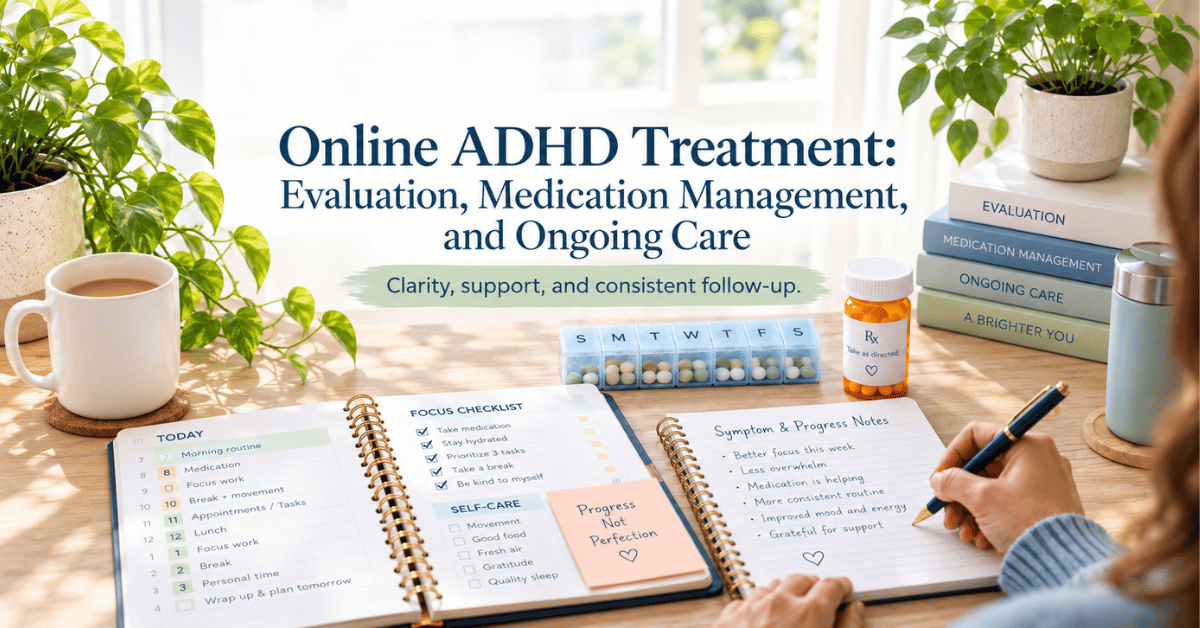
Online ADHD treatment can provide a convenient way to meet with a psychiatric provider, discuss symptoms, complete an evaluation, explore treatment options, and receive ongoing follow-up care through telepsychiatry.
However, ADHD treatment is more than scheduling a video appointment and requesting medication.
The process should begin by understanding your symptoms, history, daily functioning, and other factors that could be contributing to what you are experiencing.
This guide explains how online ADHD care works, what may happen during an evaluation, when medication management may become part of treatment, and why follow-up care matters.
Table of Contents
What Is Online ADHD Treatment?
Online ADHD treatment is ADHD-related mental health care delivered through telehealth, usually by secure video appointments.
Depending on the provider and the patient’s needs, it may include:
- Psychiatric evaluation
- Review of ADHD symptoms
- Medical and mental health history
- Discussion of daily functioning
- Diagnosis when appropriate
- Treatment planning
- Medication management
- Follow-up appointments
- Monitoring treatment response
- Coordination with other forms of care
Telepsychiatry changes where the appointment happens, not the need for an appropriate clinical evaluation.
Instead of traveling to a psychiatric office, you connect with your provider remotely.
Blue Lily Psychiatry conducts its psychiatric sessions through a virtual office using video appointments, allowing patients in supported states to receive care from home.

Can ADHD Be Evaluated Online?
ADHD can often be evaluated through telehealth when a psychiatric provider determines that a virtual assessment is appropriate.
However, diagnosing ADHD involves more than answering one question or completing a short online quiz.
ADHD is associated with persistent patterns of inattention, hyperactivity, impulsivity, or a combination of these symptoms that interfere with functioning.
Symptoms may affect areas such as:
- Work
- School
- Organization
- Relationships
- Daily responsibilities
- Time management
- Completing tasks
- Following conversations
- Keeping appointments
- Managing distractions
For an ADHD diagnosis, providers also consider how long symptoms have been present and whether they occur across different areas of life.
The CDC notes that evaluating ADHD in adults typically includes reviewing current symptoms as well as the person’s behavioral and developmental history. Providers may also consider whether another medical or mental health condition could better explain the symptoms.
That broader assessment is why an actual psychiatric evaluation is different from taking an online ADHD questionnaire by yourself.
What Happens During an Online ADHD Evaluation?
An online ADHD evaluation usually begins with a conversation about why you scheduled the appointment.
You do not need to arrive already knowing whether you have ADHD.
Your provider may ask about several areas.
Current Symptoms
ou may be asked about difficulties such as:
- Staying focused
- Completing tasks
- Managing multiple responsibilities
- Following instructions
- Losing important items
- Forgetting appointments
- Procrastinating
- Organizing your day
- Feeling restless
- Interrupting conversations
- Acting impulsively
- Becoming easily distracted
The provider may also ask how frequently these problems occur and how much they interfere with everyday life.
When the Problems Began
ADHD is a neurodevelopmental condition, which means the history of symptoms matters.
Adults who are evaluated for ADHD may be asked what they were like during childhood or adolescence.
Questions might include:
- Did you struggle to stay focused in school?
- Were assignments frequently incomplete?
- Did teachers describe you as distracted?
- Did you frequently lose homework or belongings?
- Were organization and time management difficult?
- Did similar problems occur at home?
Some people clearly remember these patterns.
Others do not.
When appropriate, providers may use old school records, previous evaluations, or information from family members or others who knew the person earlier in life as additional context.
NIMH notes that ADHD symptoms begin before age 12, even though some people are not diagnosed until adulthood.
How Symptoms Affect Your Life Today
A diagnosis is not based only on having certain personality traits.
Your provider will generally want to understand whether symptoms create meaningful problems.
For example, difficulty concentrating might lead to:
- Repeated mistakes at work
- Missed deadlines
- Difficulty studying
- Problems completing household tasks
- Frequent lateness
- Difficulty managing finances
- Forgotten appointments
- Relationship conflict
- Chronic disorganization
These examples give your provider more context than simply saying, “I have trouble focusing.”
Why an ADHD Evaluation Looks Beyond Concentration
One of the most important parts of an ADHD assessment is determining whether ADHD is actually the best explanation for the symptoms.
Difficulty concentrating can occur for many reasons.
For example, attention problems can also occur alongside:
- Anxiety
- Depression
- Sleep problems
- High levels of stress
- Substance use
- Certain medical conditions
- Other mental health conditions
- Some medications
Someone sleeping only a few hours each night may struggle to concentrate.
Someone experiencing significant anxiety may find it difficult to remain focused.
Someone experiencing depression may struggle with motivation and completing tasks.
These examples do not mean ADHD is unlikely.
They simply explain why a provider needs to look at the overall picture.
Both the CDC and NIMH emphasize that an ADHD assessment should consider other conditions that can create similar symptoms or occur alongside ADHD.

What Happens After an ADHD Evaluation?
There is no single outcome that follows every ADHD evaluation.
Your provider may determine that:
- Your symptoms are consistent with ADHD
- More information is needed
- Another condition may better explain the symptoms
- ADHD and another condition may both be contributing
- Additional medical evaluation would be useful
- Another healthcare professional should be involved
If ADHD is diagnosed, the next step is developing a treatment plan.
Treatment may involve:
- Medication
- Therapy
- Behavioral strategies
- Changes to routines
- Organizational strategies
- Sleep and lifestyle considerations
- Coaching or skills-based support
- A combination of approaches
Medication is one potential part of ADHD treatment, but it is not the only treatment option.
The CDC and NIMH both recognize medication and behavioral or psychotherapeutic approaches as common components of ADHD treatment.
Can ADHD Medication Be Prescribed Online?
ADHD medication can sometimes be prescribed through telepsychiatry, but having an online appointment does not guarantee that medication will be prescribed.
The provider first needs to evaluate whether:
- ADHD is an appropriate diagnosis
- Medication should be part of treatment
- A particular medication is appropriate
- There are relevant medical considerations
- Additional information or evaluation is needed
ADHD medications can include both stimulant and non-stimulant options.
Some stimulant ADHD medications are controlled substances and are therefore subject to additional federal and state prescribing requirements.
Telehealth prescribing rules can change, and requirements may depend on the medication, the provider, the patient’s location, and other circumstances.
For that reason, someone searching for online ADHD treatment should not assume that scheduling a virtual visit automatically means receiving a specific prescription.
Treatment decisions should follow the psychiatric evaluation.
Federal telehealth rules currently allow authorized providers to prescribe certain controlled medications through telemedicine when required conditions are met, but those rules remain subject to federal and state requirements.
ADHD Medication Management and Follow-Up Care
If medication becomes part of your ADHD treatment plan, the process generally does not end when the prescription is sent to the pharmacy.
Ongoing psychiatric medication management allows your provider to evaluate how treatment is working over time.
Follow-up appointments may include discussions about:
- Concentration
- Organization
- Impulsivity
- Restlessness
- Work or school performance
- Sleep
- Appetite
- Mood
- Anxiety
- Possible side effects
- How consistently medication is being taken
- Whether symptoms have improved
- Whether the current treatment remains appropriate
The goal is not simply to ask whether medication “works.”
The more useful question is whether treatment is helping you function better without creating problems that outweigh its benefits.
What Does a Provider Monitor During ADHD Treatment?
Several areas may be reviewed during ongoing ADHD care.
Attention and Concentration
Has it become easier to remain focused?
Can you complete tasks that previously felt difficult to finish?
Do distractions still interrupt your work as frequently?
Organization
You might notice improvement if you are:
- Missing fewer appointments
- Completing more tasks
- Managing deadlines more consistently
- Losing things less often
- Following routines more easily
Impulsivity or Restlessness
Depending on your symptoms, your provider may ask whether you are still:
- Interrupting frequently
- Making impulsive decisions
- Feeling physically restless
- Struggling to slow down
- Acting before considering consequences
Daily Functioning
ADHD treatment should not be evaluated only through a symptom checklist.
Your provider may also ask how you are doing at:
- Work
- School
- Home
- In relationships
- With routines
- Managing everyday responsibilities
Possible Side Effects
If medication is being used, your provider may also ask about any changes you have noticed since starting or adjusting treatment.
These conversations are part of medication management, not something separate from it.
What If the First Treatment Does Not Work?
ADHD treatment may require adjustments.
That does not necessarily mean something went wrong.
One person may respond well to the first approach discussed with their provider.
Another may experience limited improvement or unwanted effects.
Sometimes symptoms improve in one area while remaining difficult in another.
For example:
“I can focus longer at work, but I still struggle with organization.”
That information is useful.
During follow-up care, the provider may discuss whether to:
- Continue the current approach
- Allow more time
- Adjust treatment
- Consider another medication
- Add another type of support
- Reevaluate whether another condition is contributing
The CDC notes that effective ADHD treatment plans can involve ongoing monitoring, follow-up, and changes when needed.
This is one reason ongoing care matters.
Online ADHD Treatment for Adults
ADHD is sometimes thought of primarily as a childhood condition, but symptoms can continue into adulthood.
Some adults were diagnosed when they were younger.
Others seek an evaluation for the first time after realizing that long-standing difficulties with attention, organization, impulsivity, or completing tasks may have a broader explanation.
Adult responsibilities can also make previously manageable problems more noticeable.
For example, difficulties may become clearer when someone has to simultaneously manage:
- Full-time work
- Bills
- Household responsibilities
- Appointments
- Relationships
- Parenting
- Multiple deadlines
The CDC notes that ADHD symptoms can look different in adults and may become particularly noticeable when life demands increase.
Online psychiatric care can make seeking an evaluation easier for adults who might otherwise delay care because of work schedules, transportation, or distance from a provider.
Can Teenagers Receive ADHD Treatment Online?
Telepsychiatry may also be used for adolescent mental health care when appropriate.
The evaluation process can differ from an adult assessment because parents, school experiences, teachers, previous records, and developmental history may provide important information.
Blue Lily Psychiatry currently lists services for adolescents ages 14–17 and adults ages 18 and older.
Whether telepsychiatry is appropriate for a particular teenager depends on the provider’s evaluation, applicable state requirements, and the individual’s circumstances.
Online ADHD Treatment vs. Online Therapy
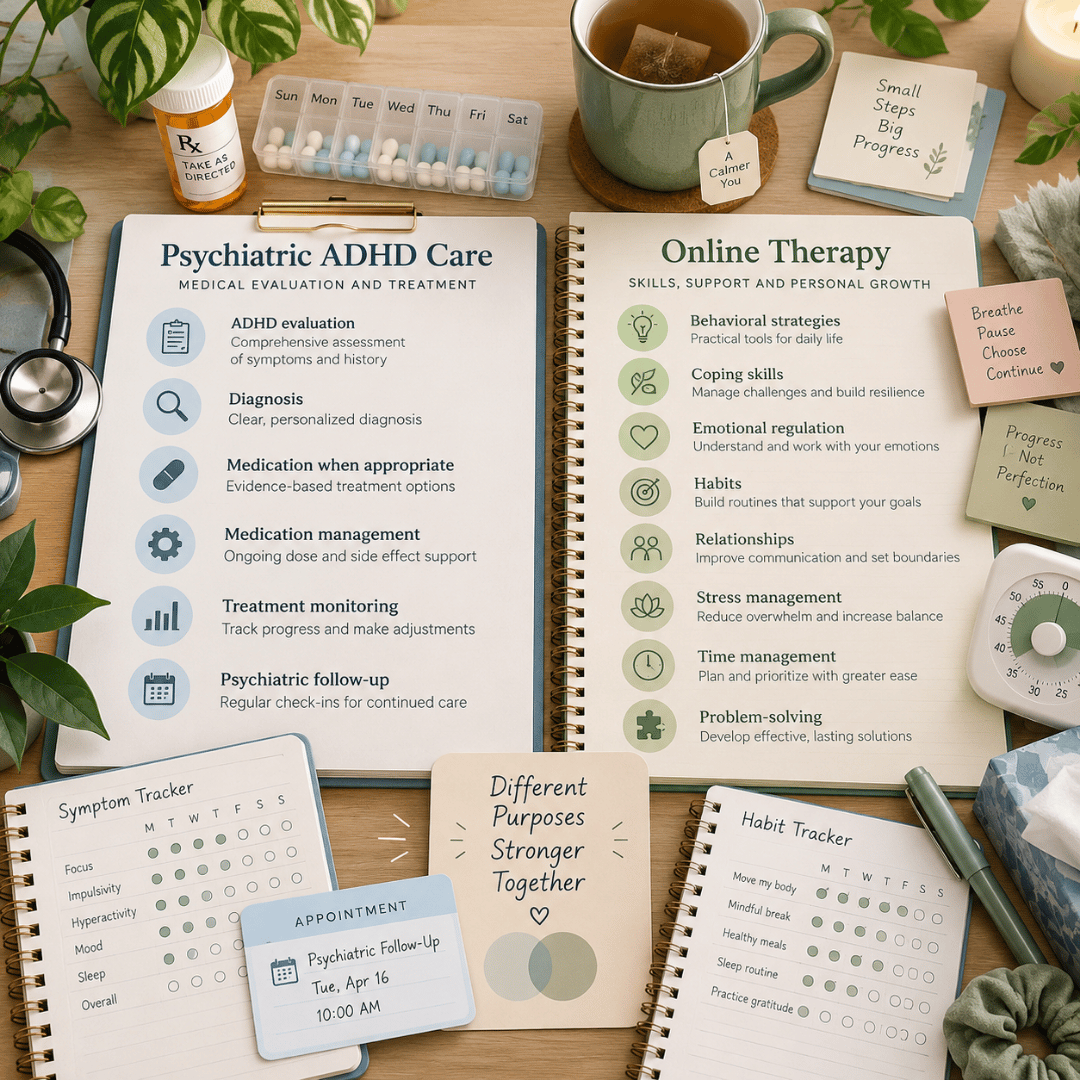
Online psychiatric ADHD care and online therapy can complement each other, but they serve different purposes.
Online Psychiatric ADHD Care
A psychiatric provider may focus on:
- ADHD evaluation
- Diagnosis
- Mental health history
- Medical considerations
- Medication when appropriate
- Medication management
- Treatment monitoring
- Psychiatric follow-up
Online Therapy
A therapist may focus more heavily on areas such as:
- Behavioral strategies
- Coping skills
- Emotional regulation
- Habits
- Relationships
- Stress management
- Time management
- Problem-solving
Some people primarily need psychiatric care.
Others use therapy.
Some benefit from both.
The right combination depends on the individual’s symptoms and treatment plan.
If you are unsure how virtual psychiatric care works more generally, you can also read our guide to online psychiatry and telepsychiatry.
How to Prepare for an Online ADHD Appointment
You do not need to prove that you have ADHD before your appointment.
Your role is simply to describe what you have been experiencing as accurately as possible.
Before your appointment, it may help to write down specific examples.
Instead of:
“I am always distracted.”
Try:
“During meetings, I often realize that I missed several minutes of the conversation.”
Instead of:
“I am disorganized.”
Try:
“I frequently forget appointments unless I set several reminders.”
You may also want to have available:
- Current medications
- Previous psychiatric medications
- Relevant medical history
- Previous mental health diagnoses
- Previous ADHD evaluations
- School records if relevant and available
- Family mental health history
- Questions about treatment
- Notes about sleep
- Examples of symptoms at work, school, and home
The goal is not to arrive with perfect documentation.
Specific examples simply make it easier for your provider to understand how symptoms affect your life.
When Online ADHD Care May Not Be Enough
Telepsychiatry can be useful for many psychiatric appointments, but not every situation can be handled entirely online.
A provider may sometimes recommend:
- Additional medical evaluation
- Laboratory testing
- Psychological testing
- Records from another healthcare professional
- An in-person examination
- Therapy
- Another specialist
- A higher level of care
That does not mean telepsychiatry has failed.
It means the provider needs additional information to make an appropriate treatment decision.
Online ADHD treatment should be viewed as a way to access psychiatric care, not as a shortcut around the normal evaluation process.
Our Services Offers
Choosing an Online ADHD Provider
When searching for ADHD treatment online, it can be tempting to focus only on how quickly an appointment is available.
There are several other questions worth considering.
Does the Provider Perform an Evaluation?
Look for care that begins with understanding your symptoms and history rather than assuming ADHD based on a short questionnaire.
Is Medication Management Available?
If medication becomes part of treatment, ongoing follow-up is important.
Ask whether the provider offers regular medication management appointments.
Who Will Provide Your Care?
Blue Lily Psychiatry’s clinical team includes board-certified Psychiatric Mental Health Nurse Practitioners who list ADHD among the conditions they treat.
You can meet the Blue Lily Psychiatry providers before scheduling.
Does the Practice Serve Your State?
Telepsychiatry providers must follow licensing requirements associated with where the patient is located.
Blue Lily Psychiatry currently provides psychiatric services across multiple licensed states. You can review current locations here.
Is Follow-Up Care Part of the Process?
ADHD treatment can evolve over time.
A practice that provides evaluation, medication management, and continued psychiatric follow-up can offer continuity beyond the initial appointment.
Getting Started With Online ADHD Treatment
If ongoing problems with concentration, organization, restlessness, impulsivity, or completing everyday tasks are affecting your life, an evaluation can help you better understand what may be contributing.
You do not need to determine on your own whether ADHD is the cause.
The purpose of the psychiatric evaluation is to look at your symptoms in context.
From there, your provider can discuss what next steps make sense.
For some people, treatment may include medication.
For others, it may involve therapy, behavioral strategies, additional evaluation, or a combination of approaches.
And when medication becomes part of the plan, ongoing follow-up helps determine how treatment is working over time.
Blue Lily Psychiatry offers telepsychiatry appointments for patients in supported states, with virtual psychiatric evaluations and ongoing care from home.
Learn more about Telepsychiatry or book an online appointment to get started.
Frequently Asked Questions About Online ADHD Treatment
Can ADHD be diagnosed through an online appointment?
ADHD can often be evaluated and diagnosed through telepsychiatry when the provider determines that virtual assessment is appropriate. An evaluation generally involves reviewing symptoms, developmental history, functioning in different settings, medical and mental health history, and other possible explanations for attention difficulties.
Can I get ADHD treatment online?
Yes. Online ADHD treatment can include psychiatric evaluation, treatment planning, medication management when appropriate, and ongoing follow-up through telepsychiatry. The exact services available depend on the provider, the patient's location, and individual circumstances.
Can you get ADHD medication through telehealth?
ADHD medication may sometimes be prescribed through telehealth after an appropriate clinical evaluation. However, an appointment does not guarantee a prescription. Some ADHD medications are controlled substances and are subject to additional federal and state requirements.
Do I need an ADHD diagnosis before scheduling an online appointment?
No. You can schedule a psychiatric evaluation because you are concerned about symptoms such as difficulty concentrating, organization problems, impulsivity, or restlessness. The provider's role is to evaluate whether those symptoms are consistent with ADHD or may have another explanation.
What happens during an online ADHD evaluation?
A provider may ask about current symptoms, childhood experiences, school or work performance, organization, attention, impulsivity, sleep, mood, anxiety, medical history, previous diagnoses, medications, and how symptoms affect everyday life.
How long does an online ADHD evaluation take?
Appointment length varies by provider and individual circumstances. ADHD assessment may sometimes require more than one conversation or additional information, particularly when developmental history, previous records, or other possible conditions need to be reviewed.
Is an online ADHD test enough to diagnose ADHD?
A self-administered online questionnaire can help identify symptoms worth discussing, but it should not be treated as a substitute for a clinical evaluation. ADHD diagnosis requires consideration of symptoms, history, impairment, and other possible explanations.
What conditions can look similar to ADHD?
Difficulty concentrating or completing tasks can occur with conditions such as anxiety, depression, sleep problems, high stress, substance use, and certain medical conditions. This is one reason a psychiatric evaluation looks at more than attention alone.
What happens after an ADHD diagnosis?
Your provider can discuss possible treatment options based on your symptoms and circumstances. Treatment may include medication, therapy, behavioral strategies, lifestyle changes, skills-based support, or a combination of approaches.
How often do you need ADHD medication follow-ups?
There is no single schedule that applies to everyone. Follow-up frequency depends on factors such as symptoms, medication response, possible side effects, recent treatment changes, and how stable the treatment plan has become.
Can adults receive ADHD treatment online?
Yes. Adults can be evaluated and treated for ADHD through telepsychiatry when virtual care is appropriate. Adults diagnosed later in life still generally need a history showing that relevant ADHD symptoms were present during childhood.
Is online ADHD treatment private?
Telepsychiatry providers are expected to follow applicable healthcare privacy requirements. Patients can also improve privacy by joining appointments from a quiet, private location and using a secure internet connection.