Magnesium is often associated with muscles, sleep, and physical health, but this essential mineral also plays an important role in the nervous system.
That connection has led to growing interest in magnesium and mental health, particularly its relationship with stress, mood, anxiety, depression, sleep, and neurotransmitter activity.
But does taking more magnesium automatically improve mental health?
Not necessarily.
Magnesium is essential for normal brain and nervous system function, and inadequate intake can affect overall health. Research has also found associations between magnesium status and certain mental health symptoms.
However, magnesium supplements should not be viewed as a stand-alone treatment for anxiety, depression, or another psychiatric condition.
This guide explains how magnesium works in the body, how it interacts with brain signaling, what research says about magnesium and mental health, which foods provide magnesium, and when supplementation may be worth discussing with a healthcare provider.
Table of Contents
What Is Magnesium?
Magnesium is an essential mineral required for hundreds of biological processes throughout the body.
The body uses magnesium in processes involving:
- Nerve function
- Muscle function
- Energy production
- Blood glucose regulation
- Blood pressure
- Protein production
- Bone health
- DNA synthesis
- Cellular signaling
The NIH Office of Dietary Supplements identifies magnesium as an essential nutrient involved in regulating muscle and nerve function, blood sugar, blood pressure, and the production of protein, bone, and DNA.
Because the nervous system depends on electrical and chemical signaling, magnesium’s involvement in cellular and neurological processes has also made it an important area of research in mental health.
Why Is Magnesium Important for Mental Health?
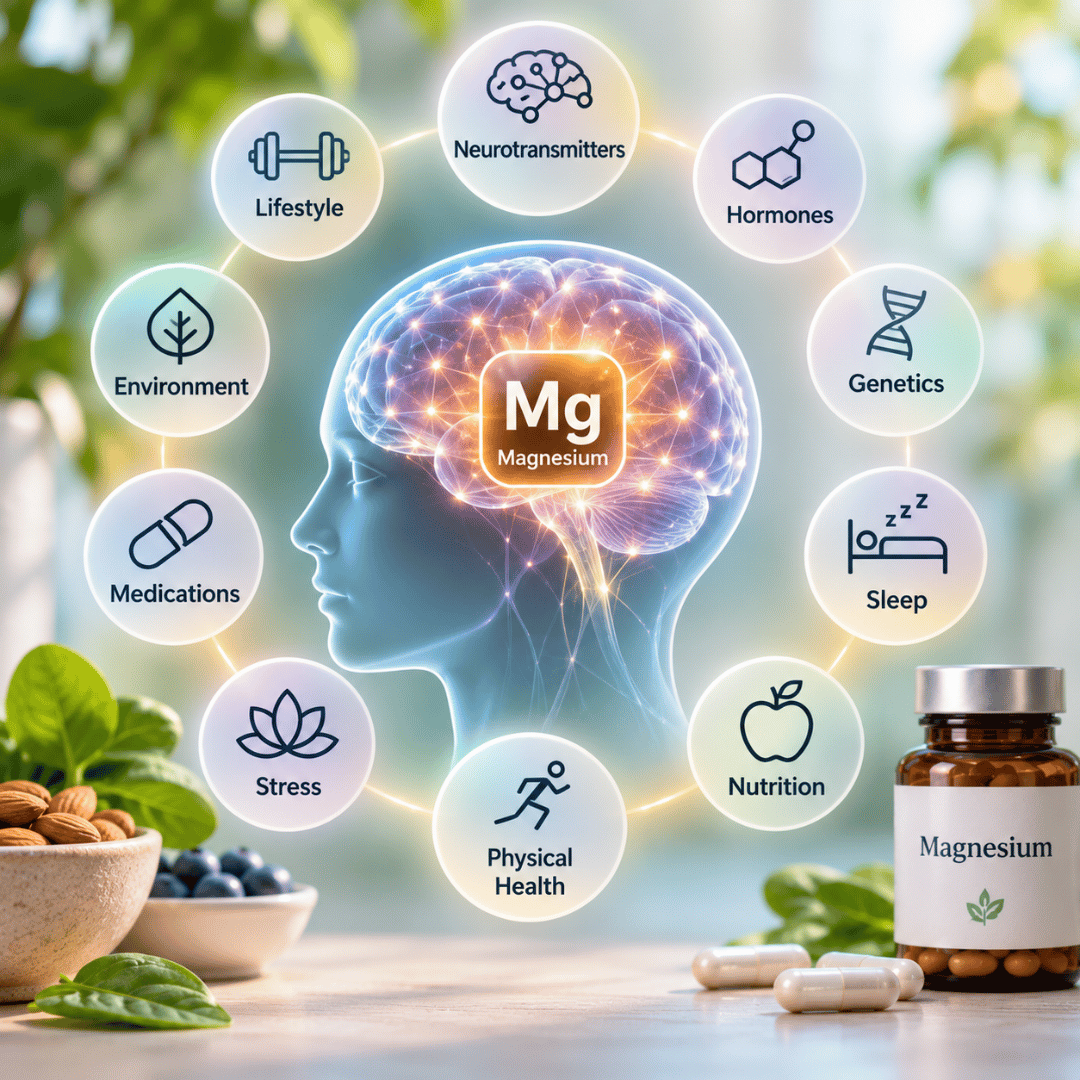
Mental health involves much more than the activity of one neurotransmitter or nutrient.
Mood, attention, stress response, sleep, and emotional regulation involve complex interactions between:
- Neurotransmitters
- Hormones
- Genetics
- Sleep
- Nutrition
- Physical health
- Stress
- Medications
- Environment
- Lifestyle
Magnesium participates in several biological processes within this broader system.
It influences neuronal excitability and helps regulate signaling involving calcium and several neurotransmitter pathways.
Researchers have therefore explored whether inadequate magnesium status could contribute to changes in mood, stress response, sleep, or other areas of mental health.
However, an important distinction should be made:
Magnesium is necessary for normal nervous system function, but that does not mean magnesium supplementation is automatically a treatment for a psychiatric disorder.
Whether supplementation is useful can depend on nutritional intake, health conditions, medications, symptoms, and other individual factors.
How Does Magnesium Affect Neurotransmitters?
Neurotransmitters are chemical messengers that allow neurons to communicate.
They influence many functions related to mental health, including:
- Mood
- Motivation
- Alertness
- Stress
- Sleep
- Memory
- Emotional regulation
- Attention
Magnesium participates in processes that influence several neurotransmitter systems.
Research has particularly examined its relationship with:
- Glutamate
- GABA
- Serotonergic pathways
- Dopaminergic pathways
- Noradrenergic signaling
Magnesium is especially important in regulating neuronal excitability.
One of the best understood examples involves the N-methyl-D-aspartate receptor, commonly called the NMDA receptor.
Research reviews describe magnesium as an important regulator of NMDA receptor activity and excitatory neurotransmission.
Magnesium, GABA, and Glutamate
Glutamate is one of the brain’s primary excitatory neurotransmitters.
GABA, or gamma-aminobutyric acid, is a major inhibitory neurotransmitter.
The nervous system depends on maintaining an appropriate balance between excitatory and inhibitory activity.
Magnesium plays a role in that balance.
At normal resting membrane potentials, magnesium helps regulate activity at NMDA receptors, which are involved in glutamate signaling.
This has led researchers to investigate how magnesium status might influence neuronal excitability, stress responses, mood, and neurological function.
Research reviews describe magnesium as an important regulator of excitatory glutamatergic and inhibitory GABA-related signaling.
That does not mean taking a magnesium supplement directly produces a sedative or anti-anxiety effect.
It means magnesium participates in biological systems that help regulate normal nervous system activity.
Magnesium and Serotonin
Serotonin is involved in many processes, including:
- Mood
- Sleep
- Appetite
- Emotional regulation
- Cognition
Nutrition can influence several parts of the serotonergic system.
Magnesium is one of multiple micronutrients that participate as cofactors in biological pathways related to serotonin synthesis and metabolism.
However, it would be inaccurate to describe magnesium simply as a supplement that “boosts serotonin.”
Serotonin regulation is far more complex and depends on factors including amino acids, enzymes, vitamins, minerals, hormones, gut function, genetics, and other biological processes.
The better way to understand magnesium is as one component of the nutritional environment required for healthy nervous system function.
Can Low Magnesium Affect Mental Health?
Researchers have examined whether lower magnesium intake or magnesium levels are associated with mental health symptoms.
Some studies have reported associations involving:
- Depression
- Anxiety
- Stress
- Sleep
- Cognitive function
However, an association does not necessarily prove that low magnesium caused those symptoms.
Mental health conditions themselves can also influence nutrition.
For example, someone experiencing depression may eat differently, have reduced appetite, sleep poorly, or have other health behaviors that affect nutrient intake.
A systematic review examining magnesium across several mental health conditions found some potentially meaningful relationships, particularly with depressive symptoms, but concluded that the overall results were not consistent enough to establish a simple relationship between magnesium levels and psychiatric disorders.
For that reason, symptoms should not automatically be attributed to magnesium deficiency.
Magnesium and Depression
The relationship between magnesium and depression has received considerable research attention.
A recent systematic review and dose-response meta-analysis involving more than 60,000 adults found an association between higher dietary magnesium intake and a lower risk of depression.
People with the highest magnesium intake had a lower observed risk than those consuming the least.
However, those results primarily came from observational research.
Observational research can identify relationships, but it cannot prove that magnesium itself prevented depression.
Researchers have also investigated magnesium supplementation.
A systematic review and meta-analysis of randomized clinical trials found improvements in depression scores among adults with depressive disorders who received magnesium supplementation.
However, only seven clinical trials involving 325 participants were included.
The authors specifically noted that larger, higher-quality randomized trials are still needed.
So the current evidence can reasonably be summarized as:
Magnesium appears relevant to depression and deserves continued research, but supplementation should not replace established depression treatment.
Magnesium and Anxiety
Magnesium is also frequently marketed for anxiety.
There is some biological rationale for studying this relationship because magnesium is involved in stress-response systems and neuronal signaling.
But the clinical evidence is considerably less certain.
A systematic review examining magnesium supplementation for anxiety and subjective stress found some studies showing improvements, particularly among people already vulnerable to anxiety.
However, the authors concluded that the quality of the available evidence was poor and that better randomized controlled trials were needed.
That means it would be premature to describe magnesium as an established anxiety treatment.
Someone experiencing persistent anxiety should consider a broader evaluation rather than assuming the symptoms are caused by inadequate magnesium.
Our Services Offers
Magnesium, Stress, and Sleep
Stress and sleep frequently overlap with mental health.
Someone who is chronically stressed may have difficulty sleeping.
Poor sleep can then contribute to:
- Irritability
- Anxiety
- Difficulty concentrating
- Low energy
- Mood changes
Because magnesium influences nervous system function, researchers have also investigated whether magnesium supplementation might improve relaxation or sleep.
Some studies have reported benefits.
Others have not.
A recent systematic review of randomized controlled trials found that evidence supporting oral magnesium as a routine treatment for insomnia remains inconsistent and of low or very low certainty.
So while adequate magnesium is important for health, taking magnesium should not automatically be expected to resolve insomnia or chronic sleep problems.
Sleep difficulties may have multiple contributing factors that deserve evaluation.
Can Magnesium Improve Cognitive Function?
Magnesium is involved in neuronal signaling and cellular processes required for healthy brain function.
Researchers have therefore explored its potential relationship with:
- Memory
- Learning
- Neuroplasticity
- Cognitive aging
- Neurodegenerative conditions
Some observational and mechanistic studies are promising.
However, there is currently not enough evidence to recommend ordinary magnesium supplementation as a general cognitive-enhancement strategy.
Research examining cognition and neurological disorders remains an active area of study.
The most appropriate goal for most people is ensuring adequate nutritional intake rather than assuming that additional magnesium beyond nutritional needs will improve cognitive performance.
How Much Magnesium Do You Need?
Magnesium requirements depend on age, sex, and life stage.
According to the NIH Office of Dietary Supplements, recommended daily amounts for most adults are:
It is important to distinguish the Recommended Dietary Allowance from the Daily Value shown on nutrition labels.
The Daily Value for magnesium used on U.S. food and supplement labels is 420 mg.
Individual recommended intake varies.
Foods High in Magnesium
For many people, food is the best place to begin when trying to increase magnesium intake.
Magnesium occurs naturally in many nutrient-dense foods.
Good dietary sources include:
Nuts and Seeds
Examples include:
- Pumpkin seeds
- Chia seeds
- Almonds
- Cashews
- Peanuts
Seeds and nuts can provide substantial amounts of magnesium in relatively small servings.
Leafy Green Vegetables
Vegetables such as spinach contain magnesium because magnesium is part of chlorophyll, the pigment responsible for the green color of plants.
Legumes
Examples include:
- Black beans
- Kidney beans
- Chickpeas
- Lentils
- Edamame
Legumes also provide fiber, protein, and other micronutrients.
Whole Grains
Whole grains can contribute magnesium along with fiber and other nutrients.
Examples include:
- Brown rice
- Oats
- Whole wheat
- Quinoa
Avocado
Avocado contains magnesium along with fiber and unsaturated fats.
Dark Chocolate
Dark chocolate can provide magnesium, although portion size, added sugar, calories, and cocoa percentage should also be considered.
Other Foods
Smaller amounts of magnesium can also come from foods such as:
- Dairy products
- Fish
- Bananas
- Certain fortified cereals
- Other vegetables
The NIH recommends obtaining nutrients primarily through a varied diet whenever possible.
Should You Get Magnesium From Food or Supplements?
For many people, improving dietary intake is a reasonable first step.
Foods containing magnesium usually provide other beneficial nutrients at the same time, including:
- Fiber
- Protein
- Healthy fats
- Vitamins
- Minerals
- Plant compounds
A supplement may sometimes be appropriate when intake is inadequate or when a healthcare professional identifies a specific reason for supplementation.
However, taking a supplement is not necessarily better than getting magnesium through food.
The appropriate approach depends on factors such as:
- Current diet
- Symptoms
- Medical conditions
- Medications
- Digestive health
- Kidney function
- Laboratory findings when relevant
- Other supplements
This is why supplementation decisions can benefit from individualized assessment.
What Types of Magnesium Supplements Are Available?
If you look at a supplement shelf, you may notice several different forms of magnesium.
Common examples include:
- Magnesium citrate
- Magnesium glycinate
- Magnesium oxide
- Magnesium chloride
- Magnesium lactate
- Magnesium aspartate
Different forms contain different amounts of elemental magnesium and can differ in absorption and gastrointestinal effects.
According to the NIH Office of Dietary Supplements, magnesium citrate, chloride, lactate, and aspartate are among forms that tend to be more readily absorbed than some other forms.
However, this does not mean one formulation is universally best for mental health.
Claims that a particular magnesium supplement specifically treats anxiety, depression, ADHD, or another psychiatric condition should be evaluated cautiously.

Is Magnesium Supplementation Safe?
Magnesium obtained naturally from food is generally not a concern for healthy individuals because the kidneys help eliminate excess magnesium.
Supplements are different.
High supplemental doses can cause:
- Diarrhea
- Nausea
- Abdominal cramping
Extremely high magnesium intake can cause more serious toxicity.
The NIH Office of Dietary Supplements sets the adult tolerable upper intake level for magnesium from supplements and medications at 350 mg per day.
Importantly, this limit does not include magnesium naturally present in food.
That distinction often causes confusion.
Someone can therefore have a total daily magnesium intake above 350 mg when dietary magnesium is included without necessarily exceeding the supplemental upper limit.
People with impaired kidney function may have a greater risk of accumulating magnesium because their bodies may have difficulty eliminating excess amounts.
Can Magnesium Interact With Medications?
Yes.
Magnesium supplements can interact with certain medications.
The NIH identifies potential interactions involving medications such as:
- Some antibiotics
- Bisphosphonates used for osteoporosis
- Certain diuretics
Some medications can also affect magnesium status.
For example, prolonged use of certain proton pump inhibitors has been associated with low magnesium levels in some people.
Because of these interactions, tell your healthcare provider about supplements you use in addition to prescription medications.
This is particularly important if you take several medications or have chronic health conditions.
How Functional and Nutritional Psychiatry Looks at Magnesium
Functional and nutritional approaches to mental health generally look at magnesium as one part of a much larger picture.
A mental health concern rarely comes down to one mineral.
Depending on the individual, a broader assessment may consider:
- Nutrition
- Vitamin and mineral status
- Sleep
- Stress
- Physical health
- Medications
- Supplements
- Laboratory findings
- Lifestyle
- Mental health symptoms
- Previous treatment
- Current psychiatric care
Blue Lily Psychiatry’s Functional & Nutritional Assessment includes evaluation of vitamin and mineral levels alongside other laboratory and health factors.
The purpose of looking at nutrition should not be to assume every psychiatric symptom has a nutritional cause.
Instead, nutritional information can provide another piece of context alongside psychiatric, medical, lifestyle, and environmental factors.
For example, rather than asking only:
“Should I take magnesium for anxiety?”
a broader evaluation might ask:
“What is contributing to my anxiety, is my nutritional intake adequate, how am I sleeping, what medications am I taking, and what treatment options make sense for my situation?”
That broader question can lead to a more individualized discussion.
When to Discuss Magnesium With a Mental Health Provider
Consider discussing magnesium or other supplements with your healthcare provider if:
- You are considering magnesium specifically for mental health symptoms
- You currently take psychiatric medication
- You take several supplements
- You have kidney disease
- You regularly experience gastrointestinal problems
- You suspect you are not meeting nutritional needs
- You have persistent anxiety or depression
- You have significant sleep difficulties
- Another healthcare professional identified low magnesium
- You are unsure whether a supplement could interact with medication
Bring the supplement bottle or product information to your appointment if possible.
Useful details include:
- Product name
- Type of magnesium
- Elemental magnesium per serving
- Number of servings taken
- Other ingredients
- Other supplements
- Current medications
This gives your provider more useful information than simply saying that you “take magnesium.”
If you want to explore nutrition, supplementation, laboratory findings, and other possible contributors to mental health symptoms, Blue Lily Psychiatry offers Functional & Nutritional Assessment as part of its current services.
You can also schedule an appointment to discuss how nutrition and supplementation may fit into your broader mental health care.
Frequently Asked Questions About Magnesium and Mental Health
Does magnesium help mental health?
Magnesium is essential for normal nervous system and brain function. Research has found associations between magnesium status and mental health outcomes, particularly depression, but evidence is not strong enough to consider magnesium supplementation a general treatment for psychiatric conditions.
Can magnesium help with anxiety?
Some studies suggest magnesium supplementation may help subjective anxiety in certain populations, but systematic reviews describe the evidence as limited and generally low quality. Persistent anxiety should be evaluated rather than treated solely with a supplement.
Does magnesium help depression?
Research has found associations between higher dietary magnesium intake and lower depression risk. Some clinical trials of supplementation have also reported improvements in depressive symptoms, but the evidence base remains relatively small. Magnesium should not replace established depression treatment.
What does magnesium do to neurotransmitters?
Magnesium helps regulate neuronal signaling, including pathways involving glutamate and NMDA receptors, and it participates in broader processes involving inhibitory and excitatory neurotransmission. Its role is complex and should not be reduced to simply “increasing” one neurotransmitter.
Does magnesium increase serotonin?
Magnesium participates as a cofactor in biological pathways related to serotonin synthesis and metabolism, but it is misleading to describe magnesium supplements as simply increasing serotonin. Serotonin regulation involves many nutrients and biological systems.
Does magnesium increase GABA?
Magnesium interacts with biological systems involved in inhibitory and excitatory neurotransmission, including GABA-related pathways. However, this does not mean a magnesium supplement acts like a GABA medication or produces a predictable anti-anxiety effect.
What foods contain the most magnesium?
Good sources include pumpkin seeds, chia seeds, nuts, legumes, whole grains, spinach and other leafy greens. Magnesium is also found in foods such as avocado and some fortified foods.
How much magnesium do adults need each day?
Most adult men need approximately 400–420 mg per day, while most adult women need approximately 310–320 mg. Requirements vary with age and life stage.
Is 420 mg the recommended amount of magnesium for everyone?
No. The 420 mg figure commonly seen on labels is the U.S. Daily Value. Individual Recommended Dietary Allowances vary according to age, sex, pregnancy, and other factors.
How do I know if I am low in magnesium?
Magnesium status cannot always be determined from symptoms alone. Diet, health history and sometimes laboratory evaluation may be considered. The NIH notes that evaluating magnesium status can require both clinical assessment and laboratory information.
What is the best type of magnesium for mental health?
There is currently insufficient evidence to identify one magnesium formulation as the best treatment for mental health conditions. Different forms vary in absorption, elemental magnesium content and gastrointestinal effects.
Can magnesium help you sleep?
Magnesium has been studied for sleep, but clinical results remain inconsistent. Current evidence does not support oral magnesium as a routine treatment for insomnia, although some individuals may experience benefits.
Is it safe to take magnesium every day?
Magnesium from food is generally safe for healthy people. Supplements can cause side effects at higher doses and may interact with medications. The NIH sets an upper limit of 350 mg per day for magnesium specifically from supplements and medications in adults unless otherwise directed by a healthcare professional.
Can magnesium interact with psychiatric medications?
Potential interactions depend on the medication and the supplement. Even when a direct interaction is not established, your prescribing provider should know which supplements you take so your overall treatment can be reviewed appropriately.
Should I take magnesium instead of psychiatric medication?
No. Magnesium supplements should not be substituted for prescribed psychiatric treatment without discussing the decision with the prescribing healthcare professional. Nutrition can be considered as one part of a broader mental health treatment plan.
Disclaimer: Although supplements do not require a prescription from a licensed healthcare professional, it is still important to consult with a qualified licensed professional to determine the appropriateness of supplementation based on individual health considerations and potential interactions with other treatments.